

In digital marketing, measuring results is just as important as executing a good strategy. Because of this, it is essential to understand what CPC, CTR, and Clicks are.
Well-planned campaigns need to be accompanied by indicators that allow you to evaluate their performance and identify opportunities for improvement.
These three metrics are among the most widely used across paid media platforms such as Google Ads and LinkedIn Ads, as well as being relevant for social media campaigns.
When analysed together, they offer a clear view of audience behaviour, ad efficiency, and return on marketing investment.
For companies operating in competitive markets, such as Ireland and other European countries, tracking these indicators is an essential practice to strengthen data-driven growth strategies.
What is CPC, CTR, and Clicks, and why are these metrics important?
Before analysing how they impact campaign performance, it is important to understand what CPC, CTR, and Clicks are.
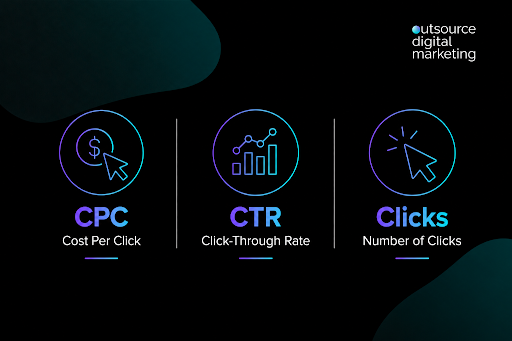
CPC, or Cost Per Click, represents the amount paid each time a user clicks on an ad.
CTR, short for Click Through Rate, indicates the percentage of clicks, meaning the relationship between the number of clicks and the number of times the ad was displayed.
Clicks, in turn, represent the total quantity of interactions made by users.
Although each metric has a specific function, they complement each other and help assess whether a campaign is successfully attracting the right audience efficiently.
How to understand what CPC, CTR, and Clicks are in practice
Each of the three metrics has its own distinctions, and knowing each one is necessary to ensure strong strategies for your business:
CPC
When understanding what CPC, CTR, and Clicks are, the first indicator that deserves attention is CPC.
This metric demonstrates how much the company is paying to bring a visitor to its website or landing page.
A high CPC can indicate strong competition for the chosen keywords or the need to optimize ads and targeting.
However, a lower cost does not always represent the best performance. In many cases, it is worth investing a bit more per click when it results in more qualified visitors with higher conversion potential.
CTR?
Another important element in understanding what CPC, CTR, and Clicks are is CTR.
Click-through rate measures the level of interest generated by an ad. The higher the CTR, the greater the relevance of the campaign tends to be for the targeted audience.
Ads with clear headlines, objective messaging, and well-structured calls to action usually present better click-through rates.
Furthermore, platforms like Google Ads use CTR as one of the factors to calculate Quality Score, which can contribute to reducing costs and improving ad placement.
Clicks
Clicks represent the first step of the user’s digital journey. When analysing what CPC, CTR, and Clicks are, it is important to remember that a click on its own does not guarantee a conversion.
However, it demonstrates that the ad managed to arouse enough interest to lead the user to the next stage.
When analysed alongside other metrics, the number of clicks helps identify optimization opportunities and evaluate the effective reach of campaigns.
What is CPC, CTR, and Clicks, and how these metrics help business growth
Companies that understand what CPC, CTR, and Clicks are can make more strategic decisions about their digital marketing investments.
These indicators allow businesses to identify which campaigns perform best, which audiences respond most positively, and which channels offer the highest return on investment.
This analysis also facilitates budget redistribution across campaigns, reducing waste and increasing the efficiency of marketing actions.
In the Irish market, where many companies compete in highly digital sectors, decisions guided by indicators like CPC, CTR, and Clicks are part of the routine for marketing and performance teams.
How to improve performance when analysing what CPC, CTR, and Clicks are
Improving these metrics requires a continuous effort of optimization. Proper targeting allows ads to be shown to people with a higher probability of interest in the offered solution.
Similarly, ads with relevant messaging aligned with search intent tend to generate more clicks and better CTR rates.
Another important aspect is the quality of the landing page. Even campaigns with good performance can lose efficiency when directing users to slow, unintuitive pages or those without a clear value proposition.
Therefore, analysing what CPC, CTR, and Clicks are means observing the entire user journey, from the ad to the conversion.
The relationship between CPC, CTR, Clicks, and other metrics
Although fundamental indicators, these metrics should not be evaluated in isolation.
When understanding what CPC, CTR, and Clicks are, it is also important to relate them to indicators such as CPA, CAC, CPL, and conversion rate.
A campaign can present an excellent CTR and low CPC, yet generate few sales if visitors do not find a suitable experience after clicking.
Similarly, a higher CPC can be perfectly acceptable when converted users offer high value to the business.
This integrated view enables more precise decisions aligned with the company’s strategic goals.
Turning marketing metrics into better business decisions
Understanding what CPC, CTR, and Clicks are is an essential step for companies wishing to develop more efficient, results-driven digital campaigns.
These metrics offer valuable information regarding audience behaviour, ad relevance, and the quality of paid media investments.
For companies operating in Ireland and other European markets, where digital competitiveness demands a high level of precision, tracking these indicators represents an important strategic advantage.
By leveraging performance indicators, our team at OSDM identifies opportunities for ongoing optimisation and budget redistribution, ensuring that every marketing action contributes to tangible growth and results.