

Knowing what CPA (Cost per Acquisition) is, is essential to ensure that your business delivers good results throughout the month.
This is because, in an increasingly competitive market, investing in digital marketing requires more than just increasing the budget allocated to campaigns.
The true differentiator lies in the ability to measure results and understand which investments actually generate a return for the business.
In this context, understanding what CPA is has become fundamental for businesses that wish to grow in a sustainable and data-driven way.
CPA, or Cost per Acquisition, is one of the main metrics used to evaluate the efficiency of marketing and advertising strategies.
More than just indicating how much was invested to generate a conversion, this metric helps managers identify optimisation opportunities and make more strategic decisions.
For companies operating in mature markets, such as Ireland and other European countries, tracking indicators like CPA is an indispensable practice to maintain competitiveness and maximise the return on investment.
What is CPA and why is it important?
Before analysing its benefits, it is essential to understand what CPA is and its importance to the business.
CPA, which stands for Cost per Acquisition, represents the average value invested for a specific action to be completed by a user.
This action can vary according to the company’s objectives, including a sale, a registration, completing a form, downloading a piece of content, or any other conversion deemed relevant to the business.
Unlike metrics that measure only clicks or impressions, CPA is directly related to the actual outcome of campaigns.
This allows companies to evaluate not only how much they invest in advertising, but primarily how much it costs to achieve a business goal.
Understanding what CPA is means understanding the real efficiency of your acquisition strategies.
How to calculate CPA correctly?
The basic CPA formula is simple:
CPA = Total Campaign Costs ÷ Number of Acquisitions
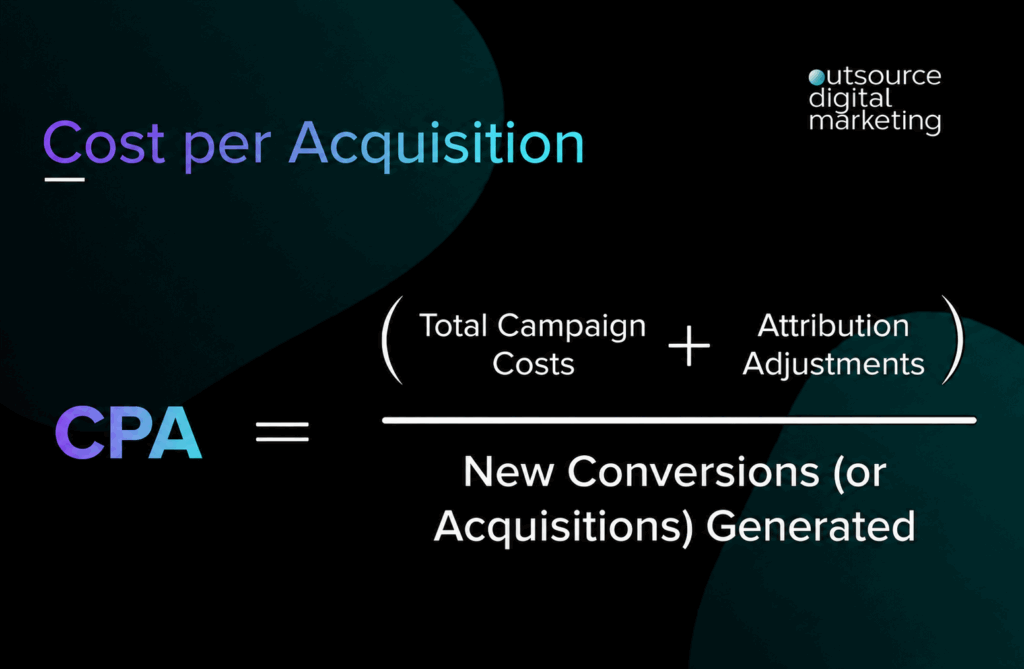
Understanding what CPA is also involves knowing how this metric is calculated.
The calculation is simple: just divide the total amount invested in a campaign by the number of acquisitions or conversions generated during the same period.
If a company invests €5,000 in adverts and obtains 100 conversions, for example, the CPA will be €50 per acquisition.
Although the formula is objective, its interpretation requires a broader analysis. A CPA considered high in a particular sector may be perfectly acceptable in another, depending on the average order value (AOV), profit margin, and the value generated by each customer.
For this reason, CPA must always be analysed within the context of the business model.
What is CPA and how it impacts company growth
One of the main reasons to understand what CPA is relates to its direct influence on operational profitability.
When a company manages to reduce the cost required to achieve a conversion without compromising the quality of results, it increases its operational efficiency.
This means that the same budget can generate more customers, more business opportunities, and a higher financial return.
For companies operating in Ireland and other European markets, where digital competition is intense, optimising CPA has become an essential strategy to scale campaigns without proportionally raising investments.
What is the difference between CPA and CAC?
When studying what CPA is, it is common for a comparison to arise with another well-known metric: CAC (Customer Acquisition Cost).
However, despite being related concepts, they have different objectives.
CAC considers all investments made by the marketing and sales departments to acquire a new customer, including salaries, tools, technology, and other operational costs.
On the other hand, CPA exclusively measures the cost of a specific conversion generated by a campaign or acquisition channel.
In practice, CPA offers a more operational view and allows for evaluating the individual performance of marketing actions, while CAC presents a broader analysis of the total cost to acquire new customers.
How to strategically reduce CPA
Understanding what CPA is also means identifying opportunities to continuously optimise this metric.
One of the most efficient ways to reduce CPA is to improve the quality of campaign targeting. The more aligned the audience is with the offer presented, the higher the chances of conversion.
Another important factor is landing page optimisation. Even campaigns with excellent performance can exhibit a high CPA when they direct users to pages that are slow, unintuitive, or have a low conversion capacity.
Additionally, constant testing of creatives, headlines, calls to action, and ad formats contributes to increasing campaign efficiency and reducing the cost per acquisition over time..
The role of data analysis in CPA management
No performance-based strategy can evolve without constant monitoring. Therefore, understanding what CPA is requires a data-driven culture.
The continuous analysis makes it possible to identify which channels perform best, which campaigns generate more qualified conversions, and which investments need to be adjusted.
Companies adopting this model can allocate their resources more efficiently, prioritising actions that offer higher returns and reducing spend on ineffective strategies.
In the European market, especially in highly digitised sectors present in Ireland, this approach has become a fundamental part of the decision-making process.
What is CPA within a Growth Marketing strategy
In the context of Growth Marketing, understanding what CPA is becomes even more relevant.
This is because this methodology is based on testing, experimentation, and continuous optimisation.
Each campaign generates data that serves as a foundation for new learnings. By tracking the CPA of different channels, ads, and audiences, the company can identify which strategies actually drive growth.
This continuous process of analysis and improvement allows for cost reduction, increased conversions, and the building of more scalable operations.
How to use CPA for smarter decisions
More than just a performance metric, CPA functions as a strategic tool to support business decisions.
Companies that understand what CPA is can define budgets with greater accuracy, set more realistic goals, and evaluate the viability of new campaigns even before expanding their investments.
Furthermore, tracking this metric facilitates comparisons between different acquisition channels, allowing resources to be directed towards the strategies that perform best.
This data-driven perspective is especially important for companies operating internationally that need to optimise investments across different markets.
Conclusion
Understanding what CPA is, is an essential step for companies wishing to develop more efficient and sustainable marketing strategies.
By measuring how much it costs to generate a conversion, this metric provides valuable insights to optimise campaigns, reduce waste, and increase the profitability of investments.
In today’s digital environment, where competition grows constantly and every decision must be data-driven, understanding what CPA is enables organisations to build smarter strategies prepared to grow consistently.
Rather than simply cutting costs, the goal is to invest better. And it is precisely this capacity for continuous optimisation that transforms CPA into one of the most relevant indicators for companies seeking sustainable growth.