

Companies that know what CPL is and use this type of tool to their advantage can obtain even more positive results for their campaigns.
The main reason for this is that in digital marketing, making decisions based solely on volume of visits or reach is no longer enough.
Companies that wish to grow in a sustainable way need to track indicators capable of demonstrating the efficiency of their business opportunity generation strategies.
In this context, understanding what CPL is has become essential to evaluate campaign performance and optimise investments.
CPL, or Cost per Lead, is one of the most widely used metrics to measure how much a company invests to generate a new qualified contact.
More than just a financial indicator, it provides valuable information on the efficiency of marketing actions and helps managers identify opportunities for improvement throughout the acquisition process.
For companies operating in highly competitive markets, such as Ireland and other European countries, understanding what CPL is represents a strategic advantage to balance growth, profitability, and scalability.
What is CPL and why is it important for marketing?
Before analysing some of its benefits, it is important to understand what CPL is and its importance to a company’s marketing department.
CPL stands for Cost per Lead. This metric represents the average value invested to generate a new lead, that is, a person who has demonstrated interest in a product or service by providing contact information, such as a name, email address, or telephone number.
Unlike sales-oriented metrics, CPL measures an earlier stage of the customer journey. Its goal is to evaluate the efficiency of attraction and capture strategies for potential consumers.
Understanding what CPL is allows companies to track campaign performance from the very beginning of the marketing funnel, identifying which actions can generate opportunities with greater efficiency.
How to calculate CPL correctly?
The basic CPL formula is simple:
CPL = (Total Marketing Costs + Cost of Content & Offers) ÷ Number of New Leads Generated
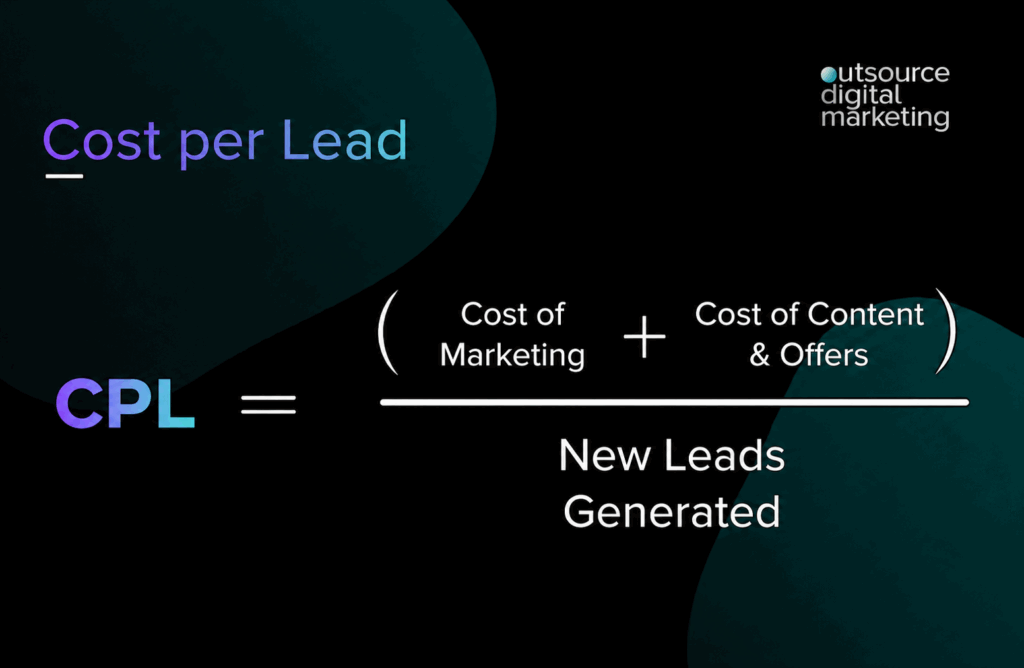
Understanding what CPL is also involves knowing how to calculate it. The formula is simple: just divide the investment made in a campaign by the number of leads generated during the same period.
If a company invests €10,000 in marketing actions and obtains 500 new leads, for example, the CPL will be €20 per lead.
Although this calculation is relatively simple, its interpretation requires a broader analysis.
A CPL considered high may be acceptable when the leads have a high probability of conversion or represent high-value opportunities for the business.
Therefore, this metric should never be analysed in isolation.
What is CPL and how it influences company growth?
One of the main reasons to understand what CPL is relates to its direct impact on growth capacity.
Companies that can generate qualified leads at a lower cost increase the efficiency of their marketing strategies and expand their conversion potential without proportionally raising their investments.
This allows campaigns to scale in a more sustainable way, maintaining a balance between opportunity acquisition and financial return.
In the Irish context, where technology, financial services, and B2B businesses co-exist with high digital competition, optimising CPL has become an indispensable practice to ensure competitiveness.
The difference between CPL, CPA, and CAC
When studying what CPL is, it is common to come across other similar metrics, such as CPA and CAC.
Despite being related, they measure different stages of the consumer journey. See below:
- CPL is focused exclusively on lead generation;
- CPA measures the cost for a specific action to be completed, such as a sale, a registration, or a material download;
- CAC represents the total cost to turn a potential customer into an actual customer, considering all investments made by the marketing and sales areas.
Understanding these differences allows companies to analyse each stage of the commercial funnel in a more strategic way.
How to reduce CPL without compromising lead quality
Reducing costs is important, but decreasing investment at any price can generate poorly qualified leads and compromise commercial performance.
Therefore, understanding what CPL is also means seeking efficiency without sacrificing quality.
A more precise segmentation is one of the factors that contribute most to improving this metric.
The more aligned the audience is to the solutions offered by the company, the higher the chances of generating relevant leads.
Another important point is the creation of content that truly addresses the needs of the audience.
Rich materials, studies, webinars, and educational content tend to attract people with a greater interest in the solution presented.
In addition, well-structured capture pages, objective forms, and a clear value proposition significantly increase conversion rates.
The role of data analysis in CPL management
Understanding what CPL is also requires continuous monitoring of results. Data analysis allows for identifying which channels generate the best leads, which campaigns show the greatest efficiency, and which investments need to be adjusted.
By monitoring indicators such as conversion rate, lead quality, and cost per channel, the company can direct its resources to strategies with a higher potential for return.
This data-driven culture is widely adopted by organisations operating in the European market, especially in Ireland, where strategic decisions are increasingly based on performance indicators.
What is CPL within Growth Marketing strategies?
In Growth Marketing, understanding what CPL is is fundamental to promote continuous improvements in the acquisition process.
As this methodology is based on constant testing, CPL functions as an important indicator to evaluate the performance of different campaigns, channels, and audiences.
By comparing results between experiments, teams can identify which actions generate leads with greater efficiency and direct efforts to more promising initiatives.
This approach reduces waste, improves investment predictability, and strengthens the company’s sustainable growth.
How to use CPL for more strategic decisions
More than just tracking costs, understanding what CPL is allows for making smarter decisions regarding resource allocation.
Companies that monitor this metric can quickly identify performance changes, adjust campaigns, and plan future investments with greater confidence.
Additionally, CPL can serve as a benchmark to compare acquisition channels, evaluate media vendors, and measure the impact of new marketing strategies.
When analysed together with indicators like CAC, CPA, and LTV, CPL offers a complete view of the commercial funnel’s efficiency.
Conclusion
Understanding what CPL is is essential for companies wishing to build more efficient and results-oriented marketing strategies.
By measuring how much it costs to generate a new lead, this metric provides important information to optimise campaigns, improve the quality of sales opportunities, and increase the efficiency of investments.
In competitive markets like the Irish and European ones, where sustainable growth depends on data-driven decisions, understanding what CPL is represents an important step to strengthen commercial performance and expand business generation capacity.
More than just reducing costs, the true goal is to generate qualified leads consistently.
And it is precisely this combination of efficiency and quality that makes CPL one of the most relevant metrics for companies wishing to grow in a strategic way.